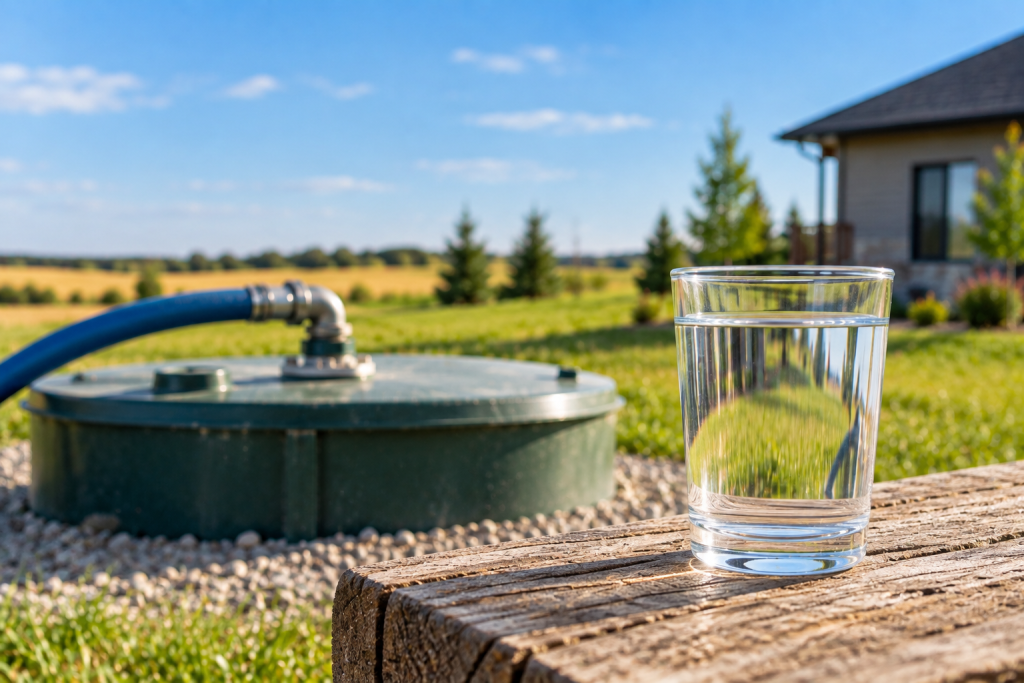

Arsenic and uranium can occur naturally in Saskatchewan groundwater, including water supplied by private wells. Neither contaminant can be reliably identified by taste, smell, or appearance. Laboratory testing is the only dependable way to determine whether these substances are present at concerning concentrations. If testing identifies elevated levels, properly selected reverse osmosis or specialized treatment systems may help reduce exposure.
Arsenic in well water in Saskatchewan is an important concern for rural homeowners who depend on groundwater for drinking, cooking, and everyday household use. Uranium is another naturally occurring element that may be present in certain groundwater sources.
Unlike hard water, which often leaves mineral buildup on faucets and fixtures, arsenic and uranium usually provide no noticeable warning signs.
Your water might look perfectly clear, taste normal, and have no unusual odor while still containing elevated concentrations of these substances.
That makes water testing especially important for Saskatchewan farms, acreages, and rural homes with private wells.
Quick Facts: Arsenic and Uranium in Well Water
Health Canada’s maximum acceptable concentration is 0.010 mg/L, equivalent to 10 micrograms per liter.
Health Canada’s maximum acceptable concentration is 0.020 mg/L, equivalent to 20 micrograms per liter.
Both elements can enter groundwater through interactions with surrounding rocks, minerals, and geological formations.
Reverse osmosis and specialized adsorption or ion-exchange systems may reduce these contaminants when correctly selected and maintained.
Why Are Arsenic and Uranium Found in Saskatchewan Groundwater?
Groundwater moves through layers of soil, sediment, and rock before reaching a private well. Along the way, it can dissolve naturally occurring minerals and trace elements.
Arsenic and uranium are two substances that may enter groundwater through these geological processes.
Their concentrations depend on factors such as:
- The geological materials surrounding the aquifer
- Groundwater chemistry and pH
- Oxygen availability and oxidation-reduction conditions
- How water interacts with minerals underground
- Local aquifer conditions
Two wells located relatively close together can have different water-quality results because they may draw water from different depths or geological formations.
That is why regional groundwater information can help identify potential concerns, but it cannot replace testing an individual well.
Is Arsenic in Well Water Common in Saskatchewan?
Arsenic occurs naturally in some Saskatchewan groundwater sources, although concentrations vary by location and aquifer.
Its presence does not necessarily indicate industrial pollution or improper agricultural practices.
Natural groundwater chemistry alone can allow arsenic to dissolve into water at concentrations that require attention.
However, homeowners should not assume every Saskatchewan well contains elevated arsenic. The actual concentration must be established through laboratory analysis.
Can Uranium Occur Naturally in Saskatchewan Wells?
Yes. Uranium is a naturally occurring element found in rocks and minerals, and it can dissolve into groundwater under certain chemical conditions.
Although Saskatchewan is known for uranium deposits and mining activity, uranium in a private well does not automatically indicate contamination from mining.
Natural geological conditions may be responsible.
The amount of dissolved uranium depends on the aquifer and surrounding water chemistry, including pH and other dissolved substances.
Laboratory testing is necessary to determine whether uranium is present and whether its concentration exceeds the drinking-water guideline.
Finding uranium in groundwater does not automatically mean the water presents a radiological hazard. Health Canada’s drinking-water guideline for uranium primarily addresses its chemical toxicity, particularly potential effects on the kidneys. Other naturally occurring radionuclides may require separate testing when indicated.
Can You Taste or Smell Arsenic and Uranium in Drinking Water?
No. Arsenic and uranium generally do not produce recognizable changes in drinking-water taste, odor, or appearance at concentrations relevant to health guidelines.
This makes them different from common aesthetic water problems such as iron staining or sulfur odors.
Clear water is not necessarily free of chemical contaminants.
Likewise, unpleasant-tasting water does not automatically mean arsenic or uranium is present.
The only reliable way to identify these contaminants is through appropriate laboratory testing.
What Are Safe Arsenic and Uranium Levels in Drinking Water?
Health Canada establishes maximum acceptable concentrations for contaminants that may affect drinking-water safety.
For arsenic and uranium, the current guideline values are:
| Contaminant | Maximum Acceptable Concentration | Primary Health Concern |
|---|---|---|
| Arsenic | 0.010 mg/L (10 µg/L) | Increased cancer risk with long-term exposure |
| Uranium | 0.020 mg/L (20 µg/L) | Potential kidney effects from prolonged exposure |
These values are maximum acceptable concentrations rather than ideal treatment targets.
For arsenic, Health Canada recommends keeping concentrations as low as reasonably achievable because it is classified as a human carcinogen.
If a private well exceeds either guideline, homeowners should seek guidance from their local public health authority and take appropriate steps to reduce exposure.
What Are the Health Risks of Arsenic in Well Water?
The primary concern with arsenic in drinking water is long-term ingestion.
Inorganic arsenic is classified as a human carcinogen. Prolonged exposure can increase the risk of certain cancers, including cancers affecting the skin, lungs, and bladder.
Other potential health effects include skin, vascular, and neurological problems.
The level of risk depends on factors such as arsenic concentration and duration of exposure.
Because these effects can develop over time, homeowners should not wait for symptoms before testing their drinking water.
What Are the Health Risks of Uranium in Groundwater?
The primary drinking-water concern associated with natural uranium is its chemical toxicity rather than its radioactivity.
Long-term ingestion of elevated uranium concentrations may affect kidney function.
Health Canada’s guideline is based on potential kidney effects associated with exposure.
As with arsenic, water testing provides a way to identify elevated concentrations before prolonged exposure continues.
How Do You Test Well Water for Arsenic and Uranium?
Testing for arsenic and uranium requires laboratory analysis capable of measuring these substances at concentrations relevant to drinking-water guidelines.
A basic hardness test, pH measurement, or total dissolved solids reading cannot determine whether either contaminant is present at an unsafe concentration.
Homeowners should request a laboratory test that specifically includes arsenic and total uranium.
What Should a Comprehensive Well Water Test Include?
Depending on the property and water source, an appropriate testing program may include:
- Arsenic
- Total uranium
- Iron and manganese
- Hardness and pH
- Total dissolved solids
- Nitrate
- Other relevant trace elements
- Total coliform bacteria and E. coli
Testing nitrate alongside uranium may be particularly useful because groundwater conditions associated with nitrate can also influence uranium mobility.
Additional testing should be guided by the well’s location, previous results, and recommendations from the laboratory or public health authority.
How Often Should Private Well Owners Test?
New wells should receive comprehensive water-quality testing before being relied upon for drinking water.
Saskatchewan’s Water Security Agency recommends regular testing of untreated well water, including comprehensive chemical and trace-metal analysis annually and bacteriological testing twice per year or whenever contamination is suspected.
Testing may also be appropriate after well repairs, flooding, significant changes in water conditions, or treatment-system installation.
Always follow laboratory sampling instructions to ensure reliable results.
What Should You Do If Your Well Water Exceeds the Guideline?
If laboratory results show arsenic or uranium above the applicable drinking-water guideline, take the result seriously and contact your local public health authority for guidance.
Depending on the circumstances, the next steps may include:
- Confirming the result with appropriate follow-up testing.
- Using an alternative drinking-water source while the concern is being addressed.
- Evaluating treatment technologies suitable for the specific contaminant.
- Installing and maintaining the selected treatment system.
- Testing treated water to verify that contaminant concentrations have been reduced adequately.
Boiling water does not remove arsenic or uranium. Evaporation can increase the concentration of dissolved contaminants in the remaining water. If your well exceeds a health-based drinking-water guideline, do not rely on boiling, ordinary pitcher filtration, or a conventional water softener as a substitute for verified treatment.
Can Reverse Osmosis Remove Arsenic and Uranium From Well Water?
Reverse osmosis is one treatment technology that may reduce dissolved arsenic and uranium in drinking water.
An RO system uses pressure to move water through a semipermeable membrane. The membrane rejects many dissolved substances, producing treated water while directing concentrated waste to a separate discharge stream.
However, removal performance varies according to the system and water chemistry.
For arsenic, treatment effectiveness can depend on the form present. Arsenic commonly occurs as arsenite, known as arsenic III, or arsenate, known as arsenic V.
Some treatment methods are more effective for arsenic V, so pretreatment or oxidation may be necessary depending on the laboratory results and treatment design.
Uranium reduction also depends on the system’s design and the chemistry of the source water.
Homeowners should select equipment with documented performance for the contaminant being treated and verify the results through follow-up testing.
Can Specialty Filter Media Remove Arsenic?
Yes. Certain specialized adsorption media can reduce arsenic under appropriate operating conditions.
Examples include iron-based adsorption media designed to capture dissolved arsenic.
Performance depends on several factors:
- Arsenic concentration and chemical form
- Water pH
- Competing dissolved substances
- Contact time and flow rate
- Media capacity and replacement schedule
Specialty media should be selected based on water chemistry rather than the assumption that any filter labeled for heavy metals will remove arsenic effectively.
Routine testing is also important because adsorption media eventually reaches its treatment capacity.
Can Ion Exchange Remove Uranium?
Specialized ion-exchange systems may be used to reduce dissolved uranium in groundwater.
These systems use selected resins that exchange ions with substances in the water.
However, resin selection, competing ions, water chemistry, regeneration, and waste handling are important considerations.
A conventional hardness softener should not automatically be considered a verified uranium treatment system.
Health Canada identifies ion exchange and reverse osmosis as treatment technologies for uranium, but notes that certified residential devices specifically claiming uranium reduction were not available at the time of its uranium guideline assessment.
That makes professional system evaluation and treated-water verification especially important.
Should You Choose Whole-Home Treatment or Drinking-Water Filtration?
The appropriate treatment location depends on the contaminant, exposure pathway, household needs, and water conditions.
Point-of-Use Treatment
A point-of-use system treats water at a specific location, such as a kitchen sink.
This may be appropriate when the primary concern is reducing exposure through drinking and cooking.
Whole-Home Treatment
A whole-home system treats water before it enters the household plumbing network.
Whole-home treatment may be considered when multiple fixtures require treated water or when other water-quality problems must also be addressed.
Because arsenic and uranium drinking-water risks are primarily associated with ingestion, whole-home treatment is not automatically necessary for every affected well.
Testing, treatment objectives, and professional guidance should determine the best approach.
Always test both untreated and treated water when evaluating a system for arsenic or uranium. A filter’s presence does not prove that contaminant concentrations have been reduced below the applicable guideline. Follow manufacturer maintenance requirements and establish a suitable retesting schedule.
Why Saskatchewan Well Owners Should Understand Their Groundwater
Private well owners across Saskatchewan may encounter water-quality challenges associated with local geology, including hardness, iron, manganese, arsenic, and uranium.
These issues are not evenly distributed across the province.
Properties near Saskatoon, Regina, Prince Albert, North Battleford, Moose Jaw, and other communities may rely on groundwater sources with different mineral and trace-element profiles.
The Saskatchewan Water Security Agency encourages rural water users to test their private supplies regularly and understand the quality of untreated groundwater before choosing treatment.
Infinite Water works with Saskatchewan homeowners, farms, and rural properties to evaluate water conditions and explore customized treatment options.
The most useful approach begins with understanding the source water, identifying contaminants that require treatment, and choosing equipment suited to those specific conditions.
Frequently Asked Questions About Arsenic and Uranium in Well Water
How do I know if my Saskatchewan well contains arsenic?
Arsenic cannot be reliably detected through taste, smell, or appearance. A laboratory test specifically measuring arsenic is needed to determine its concentration in well water.
What is the safe arsenic level in Canadian drinking water?
Health Canada’s maximum acceptable concentration for arsenic is 0.010 mg/L, or 10 micrograms per liter. Because arsenic is a human carcinogen, concentrations should be kept as low as reasonably achievable.
What is the Canadian drinking-water guideline for uranium?
Health Canada’s maximum acceptable concentration for total uranium in drinking water is 0.020 mg/L, or 20 micrograms per liter. The guideline primarily addresses potential kidney effects associated with long-term ingestion.
Will boiling well water remove arsenic or uranium?
No. Boiling does not remove dissolved arsenic or uranium and can increase their concentrations as water evaporates. Properly selected treatment or an alternative drinking-water source is needed when concentrations exceed applicable guidelines.
Does reverse osmosis remove both arsenic and uranium?
Reverse osmosis can reduce arsenic and uranium, but effectiveness depends on water chemistry, contaminant form, and equipment performance. Treatment should be selected using laboratory results and verified through follow-up testing.
Does a water softener remove arsenic and uranium?
A conventional water softener is designed primarily to reduce hardness minerals. It should not be assumed to provide reliable arsenic or uranium removal. Specialized treatment may be necessary depending on laboratory results.
Test Your Well Water Before Choosing a Treatment System
Arsenic and uranium are two groundwater contaminants that Saskatchewan homeowners cannot reliably identify without testing.
Understanding your well’s chemistry helps you determine whether treatment is necessary and which technology is appropriate.
If you’re concerned about arsenic or uranium, begin with a laboratory analysis that specifically measures both contaminants. If results exceed Canadian drinking-water guidelines, follow public health guidance and verify any treatment through additional testing.
Infinite Water offers free water testing consultations and customized treatment recommendations for Saskatchewan rural properties.
Request a Free Heavy Metals Test to discuss your well water concerns and determine which laboratory tests are needed. Confirm whether arsenic and uranium analysis is included or requires separate laboratory testing.