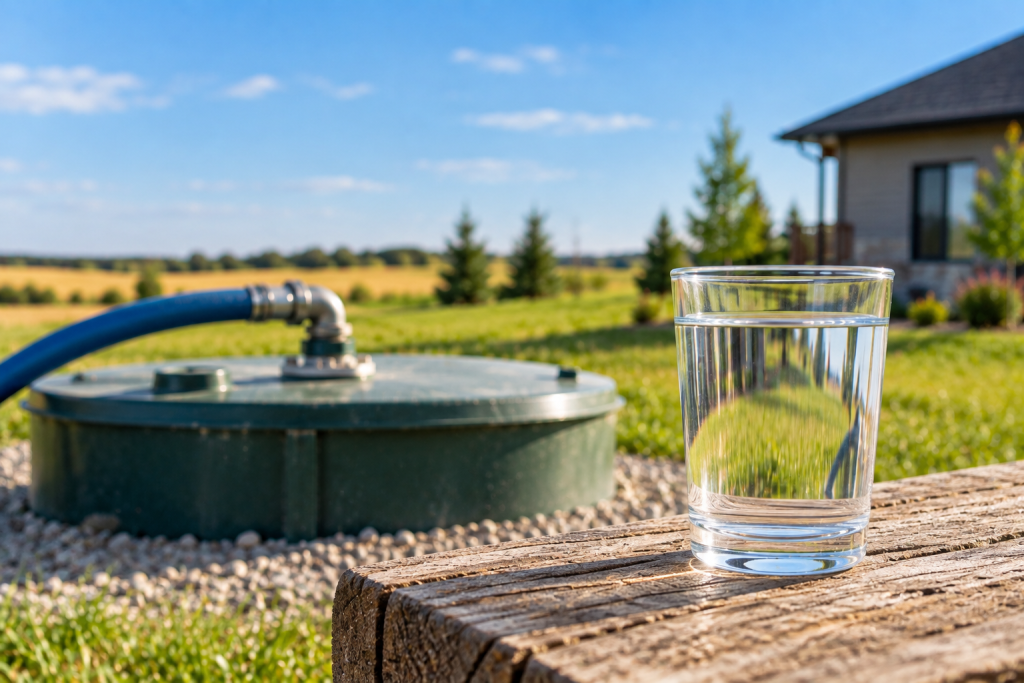

Cistern water treatment in Saskatchewan starts with protecting hauled water from delivery to tap. Even water that begins as a safe, treated supply can become contaminated during transportation, transfer, or storage. Regular cistern inspections, appropriate cleaning and disinfection, water testing, and properly selected filtration help rural homeowners maintain a dependable household water supply.
Cistern water treatment in Saskatchewan is an important consideration for households that rely on hauled water instead of a direct municipal connection or private well.
For many rural homeowners, hauling water is simply part of everyday life. A delivery truck brings potable water to the property, transfers it into a cistern, and the household uses that stored supply for drinking, cooking, cleaning, and bathing.
However, water quality can change after delivery. Contaminated transfer equipment, sediment buildup, damaged cistern covers, and inadequate maintenance can all affect the water stored on your property.
The good news? A practical maintenance routine and the right treatment setup can help reduce these risks without making water management unnecessarily complicated.
Quick Facts About Cistern Water Safety
Even treated potable water may deteriorate if storage conditions are unsanitary.
Hoses, tanks, fittings, and transfer connections should be protected from contamination.
Cleaning frequency depends on tank condition, sediment accumulation, water quality, and applicable guidance.
Sediment filtration, UV disinfection, and other technologies may be appropriate depending on the water source and test results.
How Does a Cistern Water System Work?
A cistern is a storage tank that holds water until the household needs it. In rural Saskatchewan, water may be delivered by truck and transferred into an underground or aboveground cistern.
A pump and pressure system then deliver that water through the home’s plumbing.
Unlike a direct municipal connection, hauled water passes through additional equipment before reaching the faucet. Each stage needs to be considered when evaluating water quality.
A typical system includes:
- A potable water source
- A delivery truck or transport tank
- Hoses and transfer connections
- A residential cistern
- A pump and pressure system
- Optional filtration or disinfection equipment
- Household plumbing
Keeping the entire system in good condition is just as important as starting with a reliable water source.
What Can Contaminate Hauled Water?
Hauled water contamination can occur at several points between the original water source and the household faucet.
1. Transportation and Delivery Equipment
Water delivery tanks, hoses, pumps, and fittings must be maintained in sanitary condition. Equipment exposed to dirt, debris, or unsuitable materials can introduce contaminants during transfer.
Homeowners should use a reputable potable-water delivery provider and keep their own filling connections clean and protected between deliveries.
2. Damaged Cistern Covers and Openings
A poorly sealed cistern can allow insects, debris, surface runoff, or other unwanted materials to enter the stored water.
Inspect access covers, vents, seals, and exposed connections regularly. Any damaged components should be repaired before they become a larger problem.
3. Sediment and Biofilm
Over time, sediment can accumulate inside a cistern. Biofilm may also develop on interior surfaces, particularly when storage conditions allow microorganisms to grow.
These conditions can make sanitation more difficult and may contribute to changes in water quality.
4. Extended Water Storage
Water stored for long periods may experience declining disinfectant residuals and changes in microbiological quality.
This does not mean every cistern becomes unsafe after a specific number of days. Storage conditions, water turnover, source quality, temperature, and maintenance all influence the outcome.
Clear water is not necessarily contaminant-free water. Some microbiological problems do not produce noticeable changes in appearance, taste, or odor. Water testing is more reliable than judging water quality by sight alone.
How Often Should a Water Cistern Be Cleaned?
There is no universal cistern cleaning schedule that applies to every Saskatchewan household.
The appropriate frequency depends on the cistern’s design, water source, usage, sediment accumulation, manufacturer recommendations, and water-quality history.
Health Canada guidance emphasizes maintaining cisterns in clean, sanitary condition and cleaning and disinfecting them before initial use and when system components are dismantled for repair, maintenance, or replacement.
Homeowners should establish a regular inspection routine and arrange cleaning when conditions indicate it is necessary.
Signs Your Cistern May Need Attention
- Visible sediment or debris
- Unusual taste or odor
- Changes in water clarity
- Damaged access covers or seals
- Evidence of insects or surface-water entry
- Recent plumbing or cistern repairs
- Suspected contamination during delivery
- Unsatisfactory water-test results
Cleaning may also be necessary after flooding or other events that compromise the integrity of the storage system.
How Do You Clean and Disinfect a Cistern?
Cistern cleaning generally involves removing accumulated sediment and debris, cleaning accessible surfaces, disinfecting the system, and completing any necessary flushing and water-quality verification.
The exact procedure depends on the cistern material, capacity, configuration, and condition.
For that reason, homeowners should follow manufacturer instructions and applicable public-health guidance rather than relying on an improvised chemical mixture.
Never enter a cistern without appropriate confined-space safety procedures and qualified personnel. Cleaning can involve oxygen-deficient atmospheres, hazardous gases, electrical equipment, and chemical exposure. Disinfection chemicals must also be handled and dosed correctly.
When a cistern has been contaminated, cleaning and disinfection may need to be followed by laboratory testing before the water is used for drinking.
Should You Test Water Stored in a Cistern?
Yes. Testing helps determine whether water remains suitable for household use and whether the storage system or treatment equipment requires attention.
Microbiological testing is especially important when contamination is suspected. Total coliform and E. coli testing can help identify concerns that are not detectable through taste or appearance.
Depending on the water source, other testing may also be appropriate.
Consider arranging testing when:
- A new cistern is placed into service
- The system has undergone repairs
- Floodwater or surface runoff may have entered the tank
- Contamination is suspected during delivery
- Water quality changes unexpectedly
- A treatment system is installed or serviced
- Previous testing identifies a problem
Regular monitoring should reflect the household’s water source, storage conditions, and applicable local guidance.
Infinite Water offers water testing and customized treatment recommendations for Saskatchewan rural homes. Homeowners should confirm which parameters are included in the initial test and whether separate laboratory analysis is needed for microbiological concerns.
What Is the Best Cistern Water Treatment Setup?
The best cistern water treatment system depends on the quality of the delivered water, conditions inside the cistern, and the household’s specific needs.
Some homes may need only basic sediment protection. Others may benefit from additional filtration or a microbiological treatment barrier.
Sediment Filtration
Sediment filters help capture suspended particles that could otherwise enter household plumbing or interfere with downstream equipment.
Filter selection should account for particle size, flow rate, and maintenance requirements.
Activated Carbon Filtration
Activated carbon can help reduce certain taste, odor, and chemical concerns when the filter is certified for the intended purpose.
However, carbon filtration should not be treated as a substitute for microbiological disinfection.
UV Water Disinfection
UV systems use ultraviolet light to inactivate susceptible microorganisms as water passes through a treatment chamber.
For cistern-fed homes, UV may provide an additional barrier against microbiological contamination.
Performance depends on proper system selection, water clarity, flow rate, and maintenance. Sediment or other substances that interfere with UV transmission may require pretreatment.
Reverse Osmosis
Reverse osmosis may be useful when testing identifies dissolved contaminants that require treatment beyond conventional sediment filtration.
However, RO is not automatically necessary simply because a home uses hauled water. Equipment should be selected according to the contaminants actually present.
How Should Cistern Filtration and UV Disinfection Work Together?
When UV treatment is appropriate, pretreatment is often important.
Suspended particles can interfere with UV effectiveness by blocking light from reaching microorganisms. Sediment filtration installed before the UV chamber can help maintain suitable water conditions.
A possible treatment sequence is:
Potable Water Delivery → Sanitary Cistern Storage → Pump → Sediment Filtration → UV Disinfection → Household Plumbing
This is an example, not a universal design. Depending on the water profile, additional treatment stages may be necessary, or some stages may not be needed.
The objective is to create multiple barriers against contamination while maintaining adequate household water pressure and flow.
Check filters and UV equipment according to manufacturer recommendations. Replace UV lamps at the specified interval, clean or replace sleeves when required, and investigate alarms or performance problems promptly. Even a properly installed system needs ongoing maintenance.
How Can You Keep Hauled Water Safer Between Deliveries?
Good cistern management does not need to be complicated. A few consistent habits can help protect the stored water supply.
- Use a reliable potable-water provider. Confirm that the water and delivery equipment are intended for drinking-water use.
- Protect the cistern opening. Keep covers, seals, and vents in good condition.
- Keep transfer connections sanitary. Protect hoses and fittings from dirt, insects, and other contamination.
- Inspect for sediment. Watch for buildup and arrange cleaning when needed.
- Maintain treatment equipment. Follow recommended filter and disinfection-system service schedules.
- Monitor water quality. Arrange testing when conditions warrant it and follow an appropriate ongoing monitoring plan.
- Address contamination sources. Treatment is more effective when the underlying cause of contamination is also corrected.
These practices are especially useful for seasonal properties, rural homes with variable water usage, and households that store large volumes of water between deliveries.
Cistern Water Treatment for Rural Saskatchewan Homes
Rural Saskatchewan properties have different water needs than homes connected directly to municipal distribution systems.
Across areas surrounding Saskatoon, Regina, Prince Albert, Moose Jaw, and other Saskatchewan communities, farms and acreages may depend on private wells, dugouts, or hauled-water cisterns.
Each supply has different characteristics. For cistern-fed homes, the original water quality, delivery process, storage conditions, and household plumbing all deserve attention.
Infinite Water provides rural water treatment services in Saskatchewan, including water testing, customized system recommendations, installation, and ongoing support.
Instead of automatically recommending the same filtration system for every property, treatment should begin with understanding the water and identifying the problems that actually need to be addressed.
Frequently Asked Questions About Cistern Water Treatment
Is hauled water safe to drink after being stored in a cistern?
Hauled potable water can remain suitable for drinking when transportation, transfer, and storage are properly managed. However, contamination can occur after delivery. Sanitary equipment, cistern maintenance, and appropriate water-quality monitoring are important.
How often should a drinking-water cistern be cleaned?
Cleaning frequency depends on tank condition, water source, sediment accumulation, usage, and applicable guidance. Cisterns should be cleaned and disinfected before initial use and when components are dismantled for repair, maintenance, or replacement. Additional cleaning may be necessary if contamination occurs.
Can bacteria grow in a water cistern?
Yes. Microbiological deterioration can occur when contaminants enter the system, disinfectant residuals decline, or storage conditions are not properly maintained. Cleaning, sanitary delivery practices, testing, and appropriate treatment help manage these risks.
Does cistern water need UV treatment?
Not every cistern requires UV treatment. UV may be appropriate when a microbiological treatment barrier is needed. Water testing, pretreatment requirements, system design, and maintenance should guide the decision.
Does a water softener make cistern water safe to drink?
A conventional water softener primarily reduces hardness minerals. It does not replace appropriate microbiological disinfection or treatment for other contaminants. Additional equipment may be necessary depending on the water-test results.
How do I know if my cistern water is contaminated?
Unexpected taste, odor, or appearance changes may indicate a problem, but some contaminants cannot be detected through the senses. Appropriate water testing is the most reliable way to identify water-quality concerns.
Protect Your Hauled Water From Delivery to Tap
Safe cistern water depends on more than the quality of the water delivered to your property. Transportation equipment, storage conditions, cleaning practices, household plumbing, and treatment systems all contribute to the final result.
For Saskatchewan homeowners relying on hauled water, a good first step is to review the entire system and identify any potential weaknesses.
Infinite Water can help rural homeowners explore water testing and treatment options suited to their property.
Get a Free Cistern Water Assessment to discuss your hauled-water setup and determine the next step toward a more dependable household water supply. Confirm assessment availability and scope when booking.