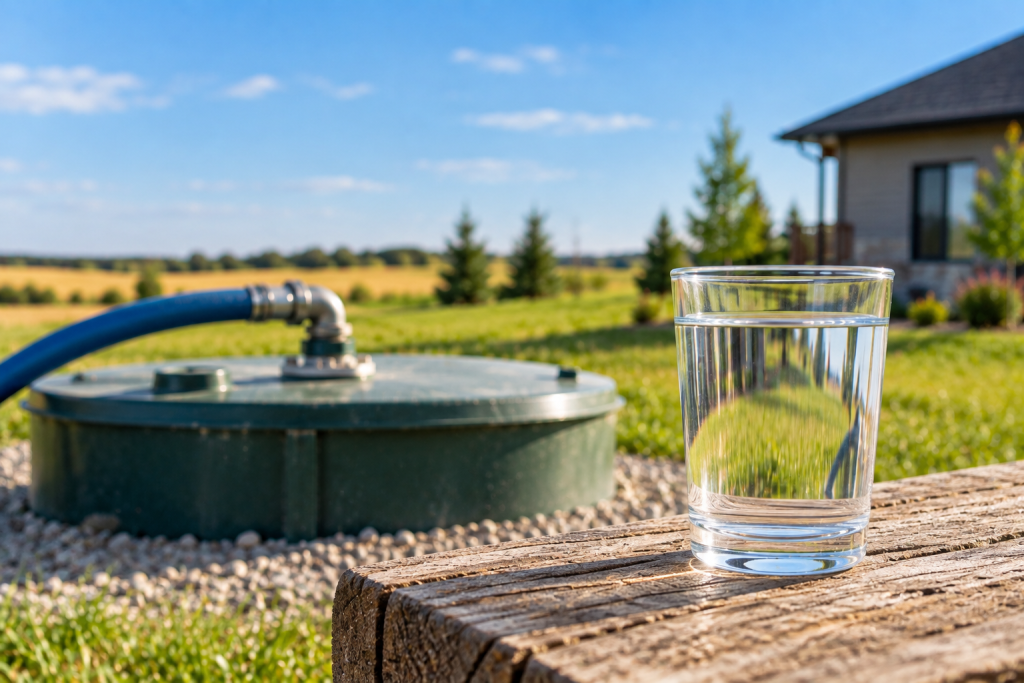


Nitrates in Saskatchewan well water can come from sources such as agricultural fertilizers, manure, septic systems, and other nitrogen-containing materials that reach groundwater. Nitrate has no obvious taste or smell, so testing is the only reliable way to determine how much is present. Health Canada sets a maximum acceptable concentration of 45 mg/L as nitrate, equivalent to 10 mg/L when measured as nitrate-nitrogen. If elevated nitrate is found, treatment should be selected based on laboratory results and the home’s overall water chemistry.
Nitrates in Saskatchewan well water deserve particular attention on farms, acreages, and other rural properties that rely on groundwater for drinking and cooking. A well may produce clear, normal-tasting water while still containing nitrate, making laboratory testing an important part of understanding private well water quality.
Nitrate occurs naturally as part of the nitrogen cycle, but human activities can also increase concentrations in groundwater. Agricultural fertilizer, manure, septic systems, and wastewater are among the potential sources.
That doesn’t mean every rural well has a nitrate problem. Risk depends on factors such as land use, soil and groundwater conditions, well depth and construction, nearby septic systems, agricultural practices, and the movement of water through the surrounding environment.
Understanding those factors — and testing the water itself — gives Saskatchewan well owners a much stronger basis for deciding whether treatment or other corrective action is necessary.
How Do Nitrates Get Into Saskatchewan Well Water?
Nitrate can enter groundwater naturally or as nitrogen-containing materials from fertilizers, manure, septic systems, and other sources move through soil and water.
Agriculture is an important consideration in rural Saskatchewan. Nitrogen fertilizers are valuable for crop production, but nitrate can move downward through soil under certain conditions and eventually reach groundwater. Manure and other animal waste can also contribute nitrogen to the surrounding environment.
Septic systems are another potential source. Wastewater contains nitrogen compounds that can eventually form nitrate. The condition, location, and maintenance of a septic system can therefore be relevant when investigating elevated nitrate in a nearby private well.
How vulnerable an individual well is depends on local conditions. Well depth and construction, groundwater movement, soil characteristics, surrounding land use, and the location of potential contamination sources can all influence nitrate levels.
For Saskatchewan farms and acreages facing multiple water concerns, understanding the broader challenges associated with farm and rural water supplies can provide additional context.
Can You Taste or Smell Nitrates in Water?
No. Nitrate does not provide a reliable taste, smell, or visual warning when it is present in drinking water.
This is one of the reasons nitrate differs from many nuisance water problems. Iron may leave orange stains. Sulfur-related compounds may create noticeable odours. Sediment may make water appear cloudy.
Nitrate can be present without any of these obvious clues.
Clear water isn’t necessarily nitrate-free water. If your property relies on a private well, laboratory testing provides information that appearance, taste, and smell cannot.
What Nitrate Level Is Acceptable in Drinking Water?
Health Canada’s maximum acceptable concentration for nitrate in drinking water is 45 mg/L when measured as nitrate. This is equivalent to 10 mg/L when measured as nitrate-nitrogen.
Understanding the units on your laboratory report is important because nitrate can be reported in either form.
For example:
- 45 mg/L as nitrate (NO3−) = Canada’s maximum acceptable concentration
- 10 mg/L as nitrate-nitrogen (NO3-N) = the equivalent concentration expressed as nitrogen
These numbers describe the same guideline using two different reporting methods. A result of 10 mg/L as nitrate is therefore very different from 10 mg/L as nitrate-nitrogen.
When reviewing a laboratory report, check both the concentration and the unit before comparing the result with a drinking-water guideline.
Who Is Most at Risk From Nitrates in Drinking Water?
Bottle-fed infants are the population of greatest concern for nitrate exposure through drinking water.
Elevated nitrate can contribute to methaemoglobinaemia, sometimes called “blue baby syndrome.” This condition interferes with the blood’s ability to carry oxygen effectively.
The risk is particularly relevant when contaminated well water is used to prepare infant formula. Health Canada’s nitrate guideline was established to protect bottle-fed infants, the population considered most sensitive to this effect.
Because this is a health-related contaminant rather than simply an aesthetic water problem, homeowners with elevated nitrate results should follow guidance from the appropriate health or drinking-water authority rather than relying only on changes in taste or appearance.
Does Boiling Well Water Remove Nitrates?
No. Boiling water does not remove nitrate.
Boiling removes some water through evaporation while nitrate remains behind. As a result, boiling can increase the nitrate concentration in the remaining water rather than making nitrate-contaminated water safer.
This is an important distinction because boiling can be useful in certain microbiological water advisories, but it should not be treated as a solution for nitrate contamination.
How Should Saskatchewan Well Water Be Tested for Nitrates?
Nitrate concerns should be evaluated using appropriate water analysis that specifically measures nitrate concentration.
A general water assessment can help identify potential water quality concerns, but homeowners should confirm that nitrate is included when testing for this particular contaminant. Depending on the situation, analysis through an appropriate laboratory may be necessary.
Testing becomes especially useful when:
- A property relies on a private well
- Fertilizer or manure is used or stored nearby
- A septic system is located on the property
- Land use around the well has changed
- Previous testing found elevated nitrate
- The well is shallow or potentially vulnerable to surface influences
- An infant will be consuming formula prepared with the well water
Testing for nitrate shouldn’t necessarily occur in isolation. Private well owners may also need to consider bacterial and other chemical parameters depending on their water source and local conditions.
Homeowners who want to start evaluating their water can learn more about Infinite Water’s water testing process and determine whether additional laboratory analysis is appropriate.
Can Reverse Osmosis Reduce Nitrates?
Yes. Properly selected reverse osmosis systems can reduce nitrate concentrations in drinking water.
Reverse osmosis uses a semipermeable membrane to reduce a range of dissolved substances as water passes through the treatment system. For homes primarily concerned about drinking and cooking water, a point-of-use RO system may be an option when the specific unit is designed and certified for nitrate reduction.
Performance varies between systems, however. Membrane type, incoming water chemistry, nitrate concentration, pressure, system condition, and maintenance can all affect treatment performance.
Homeowners should therefore look for equipment specifically rated for the contaminant being treated rather than assuming every RO system provides the same level of nitrate reduction.
Those comparing drinking-water treatment technologies can learn more about reverse osmosis and water treatment systems.
Can Ion Exchange Remove Nitrates?
Nitrate-selective ion exchange is another treatment method that can reduce nitrate in drinking water when the system is properly designed and operated.
Ion exchange for nitrate treatment uses specialized resin to exchange nitrate ions for other ions as water passes through the system. This should not be confused with assuming that an ordinary residential water softener automatically treats nitrate.
Standard water softeners are primarily designed to reduce hardness minerals such as calcium and magnesium. Nitrate treatment requires equipment and media intended for that purpose.
Other dissolved substances in the water can also affect ion-exchange performance. That’s another reason complete water chemistry should be considered before choosing treatment equipment.
How Can Rural Homeowners Reduce the Risk of Nitrate Contamination?
Preventing nitrate contamination often requires looking beyond the treatment equipment inside the home and considering what is happening around the water source.
Helpful practices can include:
- Maintaining septic systems properly
- Keeping wells in good physical condition
- Following appropriate separation distances between wells and potential contamination sources
- Managing manure responsibly
- Using fertilizers according to appropriate agricultural practices
- Preventing unnecessary pooling or drainage problems around the well
- Testing well water periodically and after meaningful changes around the property
If elevated nitrate is found, identifying possible sources can be just as important as selecting treatment. A treatment system may reduce nitrate at the tap, but addressing a preventable contamination pathway can provide additional long-term protection for the water source.
Local Authority: Nitrate Concerns for Saskatchewan Farms and Acreages
Saskatchewan’s agricultural landscape makes groundwater an essential resource for many rural families, farms, and acreages. At the same time, agricultural activity, private septic systems, and local groundwater conditions mean that rural water quality can differ significantly from one property to another.
That variability is why testing matters. One nearby well’s results should not be assumed to represent another property’s water.
Infinite Water works with Saskatchewan homeowners to understand individual water conditions before recommending treatment. When nitrate is a concern, that process should consider the measured nitrate concentration along with other relevant water chemistry rather than selecting equipment based on assumptions.
For homeowners dealing with multiple concerns, understanding drinking water quality in Saskatchewan can help put nitrate testing into the context of a complete water-quality plan.
What nitrate level is considered acceptable in Canadian drinking water?
Can babies drink well water containing nitrates?
Does boiling well water remove nitrates?
Can a normal water softener remove nitrates?
Does reverse osmosis reduce nitrates?
How do I test my Saskatchewan well for nitrates?
Know What’s in Your Well Water Before Choosing Treatment
Nitrate contamination cannot be diagnosed by looking at a glass of water. Clear, normal-tasting well water can still contain nitrate, which makes proper testing the foundation of any treatment decision.
For Saskatchewan farms, acreages, and rural homes, understanding potential sources is equally important. Fertilizer, manure, septic systems, groundwater conditions, and well characteristics can all influence nitrate risk.
If testing identifies elevated nitrate, technologies such as properly selected reverse osmosis or nitrate-specific ion exchange may help reduce concentrations. The right approach depends on the actual test results, water chemistry, household needs, and the source of the problem.
Start by understanding the water you have. From there, you can make informed decisions about source protection, ongoing monitoring, and treatment that matches your Saskatchewan property’s specific needs.